Classification
1. Shapes

The round pearl (R) is a perfect sphere, meaning that the variation in its diameter must be less than 2% of the smallest diameter!

The circled pearl (CL) has concentric circles, in the form of ridges or grooves, over more than a third of its surface.
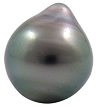
The semi-baroque / drop pearl has at least one axis of symmetry.

The baroque pearl (B), irregular and/or abstract in shape, is asymmetrical by nature.

“Keshis” are small, asymmetrical cultured pearls without a nucleus, formed when the oyster rejects the nucleus and keeps only the small graft. The mother-of-pearl then produces a pearl of variable shape with no nucleus.
The minimum thickness of the pearl layer between the nucleus and the outer surface of a Tahitian cultured pearl is set at 0.8 mm. The average size is generally between 7 and 12 mm and can reach up to 16 mm, and exceptionally 17, 18, 19 or 20 mm.
2. Quality

TOP GEM
Pearl with an exceptional surface quality
Excellent lustre

GRADE A
One or more imperfections grouped over less than 10% of the surface
Fine lustre, fine orient

GRADE B
A few imperfections over less than 30% of the surface
Fine lustre, fine orient

GRADE C
Visible imperfections over less than 60% of the surface
Average lustre, average orient

GRADE D
Significant or deep flaws over less than 60% of the surface
Regardless of lustre
REJECTS
These are pearls with insufficient coating (less than 0.8 mm of nacre). Their sale and commercial use are prohibited
3. Colours
Colour varies according to the variety of oyster, the natural environment, the choice of graft and... luck!
From the softest pink to immaculate white, from shades of grey to shimmering black, with pastel, iridescent or deep overtones of bronze, pistachio, blue, mauve, green, aubergine or gunmetal, nature creates an incredible maze of luminous and sumptuous hues. Born of a living organism, each pearl, through its size, shape and colour, offers a unique material that contributes to the splendour of a piece of jewellery.
From the softest pink to immaculate white, from shades of grey to shimmering black, with pastel, iridescent or deep overtones of bronze, pistachio, blue, mauve, green, aubergine or gunmetal, nature creates an incredible maze of luminous and sumptuous hues. Born of a living organism, each pearl, through its size, shape and colour, offers a unique material that contributes to the splendour of a piece of jewellery.

From the most understated elegance to the boldest extravagance, the pearl is the centrepiece of fine jewellery design, enriching with its lustre the materials that set it off. Its colour determines the metal used and the stones that will be matched with it.
Even though rarity makes certain hues more sought after, a pearl's beauty does not depend on its colour. Living things, pearls have a presence, a language and a life of their own that follow our days and our moods: above all, it is a matter of personal choice.
Even though rarity makes certain hues more sought after, a pearl's beauty does not depend on its colour. Living things, pearls have a presence, a language and a life of their own that follow our days and our moods: above all, it is a matter of personal choice.
